I am a web developer and software engineer currently living in Delhi, India. My interests range from technology to entrepreneurship. I am also interested in running, fitness, and programming.
How a web browser works
Get link
Facebook
X
Pinterest
Email
Other Apps
-
DNS resolution
tcp connection
hand shaking
understand with the help of chrome dev tools request pipeline
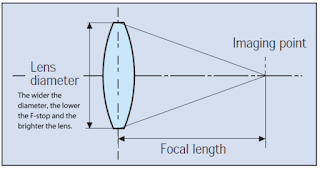
1. What if focal length Focal length is the distance from the center of the lens to the imaging point 2. Focal length and aperture relation: The aperture is a fraction that describes the ratio of aperture (entrance pupil) diameter to focal length. 3. How to differentiate between lenses: Camera name itself says, like: Nikon 18-55mm f/3.5-5.6 AF-P. Maximum aperture is f/3.5 but it shifts gradually from f/3.5 at the wide end to just f/5.6 at the longer focal lengths. It can be identified by column as well, like:Nikon 50mm 1:1.4G(Max aperture f/1.4). Nows lets get into the details: 1. What is focal length: Focal length is the distance from the center of the lens to the imaging point (focal plane) where the light for the image is collected. When a lens is described as a "50mm lens," it is referring to its focal length. Different focal lengths create different levels of magnification and change the viewing angle of the resulting photograph. As the focal length value decreases, the ...
Timing breakdown phases explained Here's more information about each of the phases you may see in the Timing tab: Queueing (no-color, transparent, white ) . The browser queues requests when: The request was postponed by the rendering engine because it's considered lower priority than critical resources (such as scripts/styles). This often happens with images. The request was put on hold to wait for an unavailable TCP socket that's about to free up. The request was put on hold because the browser only allows six TCP connections per origin on HTTP 1. Time spent making disk cache entries (typically very quick.) Stalled/Blocking (grey) . Time the request spent waiting before it could be sent. It can be waiting for any of the reasons described for Queueing. Additionally, this time is inclusive of any time spent in proxy negotiation. Proxy Negotiation (grey): Time spent negotiating with a proxy server connection. DNS Lookup (Dark green) . Time spent p...
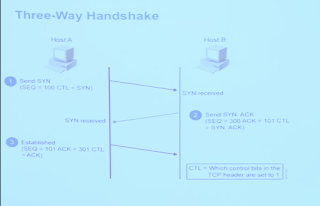
Three way handshake: 1. A ------SYN------> B 2. B ---SYN + ACK---> A 3. A ------ACK------> B Detailed version: 1. A ------(SEQ = 100, CTL = SYN)------> B 2. B ---(SEQ=300, ACK=101, CTL=(SYN, ACK)---> A 3. A ------(ACK=301, SEQ=101, CTL=ACK)------> B The sequence number is the byte number of the first byte of data in the TCP packet sent (also called a TCP segment). The acknowledgement number is the sequence number of the next byte the receiver expects to receive. The receiver ack'ing sequence number x acknowledges receipt of all data bytes less than (but not including) byte number x. Note: There is no such machanism in UDP, this is all based on TCP Thus the TCP handshaking is required for handshaking and flow control. src: https://www.youtube.com/watch?v=LyDqA-dAPW4 https://networkengineering.stackexchange.com/questions/24068/why-do-we-need-a-3-way- handshake-why-not-just-2-way http://www.cs.miami.edu/home/burt/learning/Cs...
Comments
Post a Comment